
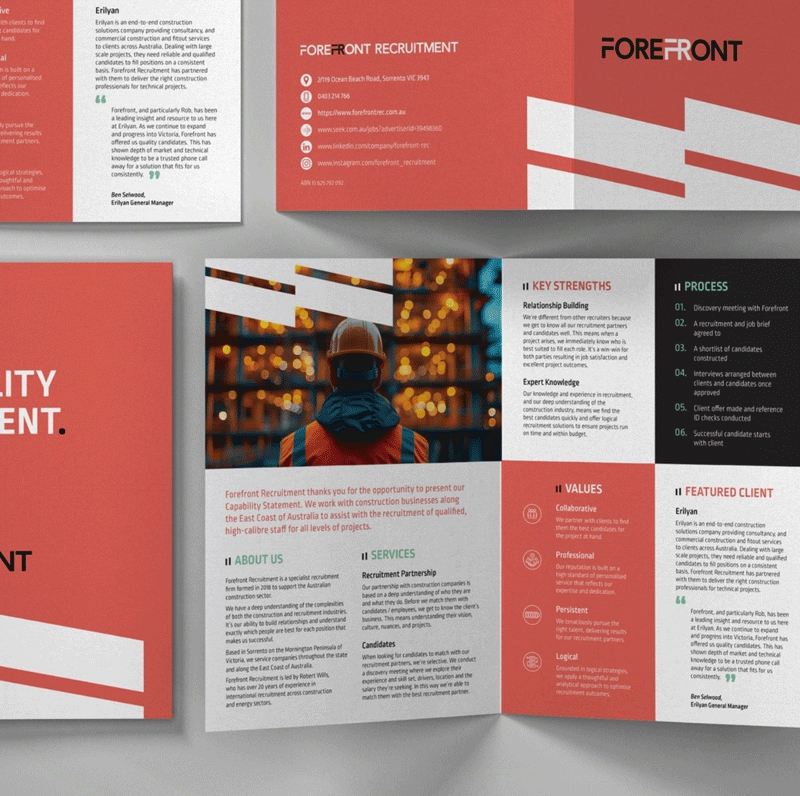
Your capability statement is often the first thing a procurement manager, head contractor or council sees about your business. Often, before they've even visited your website, met your team or read your tender, it tells them who you are, what you can do and why they should trust you with their project.
Get it right, and it opens doors and wins you projects. Get it wrong, and you may never hear back or know the reason why you failed to make an impression.
This guide explains how to write a capability statement that becomes a winning asset for your business. It includes what information to add, what to leave out, and the mistakes to avoid.
What is a capability statement?
A capability statement is a professionally designed document that summarises your business' experience, expertise and credentials. I liken it to a résumé for your company.
Construction businesses use them to:
- respond to expressions of interest (EOIs) and tenders
- apply for prequalification with government agencies and head contractors
- introduce themselves to new clients and partners
- follow up after a meeting or site visit
- give prospective clients something to download from their website
It's a sales document as much as a summary. Every section should answer the question your reader is asking: why should we trust this business with our project?
When I first started as a copywriter, I had no idea what a capability statement was. Since then, I've written and designed many construction capability statements with the help of my dedicated design teams in Sydney and Darwin.
I've also had plenty of business owners tell me they've been in business for more than 20 years and never needed one. Now they're being asked for one even on smaller jobs, as more clients expect a capability statement as standard.
How to write a capability statement, step by step
1. Know who will read it
Before you write anything, decide who your capability statement is for. A council assessing a tender, a Tier 1 head contractor looking for subcontractors, and a private developer all care about different things. The more clearly you picture your reader, the easier it is to decide what to include and what to leave out.
2. Get clear on what makes you different
Work out why a client should choose you over your competitors. This becomes your unique selling proposition (USP), and everything else in your capability statement should support it. If you're struggling to put it into words, ask your best clients why they keep coming back.
3. Choose projects that match the work you want
Shortlist the projects that best show your capability for the work you're chasing, not just the biggest or most recent. Gather the details for each: client, location, value, completion date, scope, and the problem you solved.
4. Gather your evidence
Pull together everything that backs up your claims: accreditations, licences, insurances, awards, safety statistics, client testimonials, team qualifications and high-resolution project photos. Finding these early saves a lot of chasing later.
5. Write in plain English
Procurement teams read a lot of capability statements, often quickly. Skip the jargon and corporate buzzwords, and say what you do in the words you'd use with a client on site. Use clear headings, short paragraphs and concrete details. "Delivered 12 km of rural road upgrades for three regional councils" says far more than "extensive civil experience".
6. Get it professionally designed
Design isn't just nice-to-have decoration. It makes your content easier to scan, puts your strongest information where people will see it, and shows the same care you put into your projects. More on this below.
7. Review it, then keep it current
Have someone outside your business read it before you send it. Then keep it up to date, because a capability statement with old projects or expired certifications does more harm than good. More on that below.
Capability statement checklist
Here's a quick checklist of what could be included in a construction capability statement:
- Your unique selling proposition (USP)
- Company overview
- Core services and capabilities
- Sectors and project types
- Key strengths
- Key projects
- Photos
- Your process
- Values
- Key personnel
- Plant and equipment
- Safety
- Quality and environmental management
- Accreditations, licences and prequalification
- Awards and recognition
- Policies that matter to your clients
- Insurances
- Past clients and testimonials
- Service areas
- Contact details and ABN
You won't always need all 20. But here's what goes into each of the categories listed.
The essential things to include in a capability statement
These are the sections almost every capability statement needs, whether it's a four-page introduction or a full tender document.
Your unique selling proposition
This is the most important part of your capability statement, and the one most businesses get wrong. Your USP is the clear, specific reason a client should choose you over everyone else.
"Quality workmanship" and "competitive pricing" aren't USPs. Every one of your competitors says them too. Your USP might be a specialist capability, a track record in a particular sector, an innovative method or the way you work with clients.
Whatever it is, it should be obvious within seconds of someone opening your document. Put it on the cover or the first page, not buried on page six.
Company overview
A short summary of who you are: how long you've been operating, where you work, how big your team is and the kind of projects you deliver. Keep it to a few short sentences or paragraphs. Your clients care more about what you can do for them than about your company's history.
Core services and capabilities
List the services you provide, with a sentence or two on each if necessary. Name the actual work, such as bulk earthworks, road construction or stormwater drainage, and who you do it for, so a procurement manager can see at a glance whether you're the right fit
Sectors and project types
Tell readers which sectors you work in, such as education, health, commercial, residential, industrial or infrastructure, and the types of projects you deliver within them. It helps a procurement manager see at a glance whether you're the right fit.
Key strengths
What does your business do especially well? It could be your safety record, delivering in tight timeframes, working on complex or live sites, or having plant and expertise in-house.
I usually recommend three to five strengths, each with a short heading and a sentence or two explaining. Strengths back up your USP with substance.
Key projects
Projects are your proof. For each one, include:
- project name
- client (if you can disclose it)
- location
- value or scale (if you can/want to disclose it)
- completion date or timeframe
- scope of works
- the challenge, how you solved it, and the result
- a client testimonial, if you have one
Choose projects that match the work you want to win, not just the biggest or the most recent. If you're chasing more council work, lead with your council projects.
If you already have case studies, they're a ready-made source for this section. My post on how case studies drive business growth explains what makes a project story persuasive.
Photos
A capability statement without photos asks clients to take your word for it, or imagine your projects Real images of your projects, team and equipment show them.
Use high-resolution photos of your own work, not stock images, and make sure every photo shows safe work practices. An assessor will notice a missing harness long before they notice your nice sunset shot. My construction photography tips will help you get better shots, even on your phone.
Contact details
Make it easy for people to get in touch. Include your key contact and their role, phone, email, website, address, ABN and company legal name. These usually go on the last page or inside the back cover, depending on the capability statement's size and design.
Sections that build credibility
Once the essentials are covered, these sections show clients how you work, not just what you build. Their inclusion depends on how established your business is, and how long the capability statement is.
Your process
A simple, numbered outline of how you take a project from first contact to handover. For example: enquiry, site visit, quote, planning, construction, handover and follow-up. It reassures clients that you're organised and that there won't be surprises. I usually recommend including this only if your target audience is likely to be unfamiliar with the process.
Values
Three to five values — sometimes we include these as icons, and other times we list them with a brief explanation. We assess each capability statement individually when deciding.
Key personnel
Introduce the people who'll actually deliver the work, with their role, qualifications and years of experience. Clients hire people, not logos. For larger businesses, an organisation chart can show how your team is structured.
Plant and equipment
If your own plant and equipment is part of your capability, list the key items. It shows you can deliver without relying on hire, and that you can mobilise quickly.
Awards and recognition
Recent industry awards, finalist placings and recognition from clients all build credibility quickly. If you have them, include them.
Clients and testimonials
A short list of past clients, a row of client logos, or a strong quote from a satisfied client adds instant credibility. A testimonial that names a specific result is worth more than one that says you were "great to work with". If you're not sure how to get good quotes, my client interview tips can help.
Service areas
Where do you work? Listing your regions, or including a simple map, saves clients from wondering whether you'll travel to their site.
Sections for tenders and major contracts
If you're bidding for government work or trying to get onto a Tier 1 contractor's panel, these sections are often expected. For some tenders, they aren't optional.
Safety
In construction, safety is a baseline expectation. Show how your business manages it in practice: your WHS management system, your record, your training, and how safety works on site day to day.
Tender assessors can tell a copied policy from a business that genuinely lives it. Specific details, like how often you run toolbox talks or how you manage subcontractors, show the difference.
Quality and environmental management
Outline how you manage quality, such as your inspection and test plans, how you handle defects and how you keep records. Do the same for environmental management, including how you manage waste, noise and sediment on site.
Accreditations, licences and prequalification
List the accreditations, licences and registrations relevant to your work. These might include:
- quality, safety and environmental management certifications (for example, ISO 9001, ISO 45001 and ISO 14001)
- government prequalification
- contractor licences and trade licences
- industry association memberships
Include the certifying body, and the number and expiry date where relevant.
Company policies
Clients increasingly want to know how you operate, not just what you build. If you have policies on diversity, equity and inclusion, sustainability, Indigenous engagement or community involvement, include the ones relevant to your clients.
On government projects, social outcomes can count towards your score. I've written more about this in Why business isn't just about profit.
Insurances
List your key insurances, such as public liability, workers compensation, professional indemnity and contract works. Include the insurer and cover amount where appropriate. Some businesses prefer to share full policy details only on request, which is fine for an introductory version.
How long should a capability statement be?
My honest answer to this would be, as long as it needs to be. That doesn't mean reams of information. It means setting out the information your reader needs, in a design that makes it easy to read and attractive to look at.
In my experience, most construction capability statements fall into three lengths:
- Around 4 pages*: a focused introduction covering your USP, services, strengths, one or two key projects and contact details. Ideal for newer businesses, or for a targeted, sector-specific version.
- Around 8 to 12 pages*: a comprehensive statement covering all the key areas, including your process, team and two to three projects.
- Up to 20 pages*: a full tender-ready document with safety, quality, accreditations, insurances, policies and 3 to 4 detailed projects.
*These include front and back covers
Still not sure? Get in touch, and I'll help you work out what yours needs.
If you're designing for print, keep the page count in multiples of four so it folds and binds properly.
But whatever the length, assume your reader will skim. Clear headings, short paragraphs and specific details matter more than page count.
Tailor it to your reader
One capability statement rarely suits every audience. Each type of client reads it looking for something different.
Government and councils
Government buyers are accountable for public money, so they look for evidence that you're low risk. Lead with prequalification, safety and quality systems, relevant government projects and social outcomes such as local jobs, apprentices and Indigenous participation.
Tier 1 and head contractors
Head contractors want subcontractors who'll turn up, deliver to program and won't create problems on their site. Show your capacity, your safety systems, your plant and people, and projects where you've worked under a head contractor.
Private clients and developers
Private clients often care most about reliability, communication and value. Lead with relevant projects, testimonials, your process and the way you work with clients.
Create a version for each market
If you work across several sectors, consider creating targeted versions that lead with the most relevant projects, capabilities and credentials for each one. Clients with a residential and a commercial arm, for example, usually have a separate document designed for each, so they can confidently lead with the right one.
A focused document tells every reader "we specialise in your kind of project". A one-size-fits-all document often tells them "we do a bit of everything".
Capability statement vs company profile vs tender response
These three documents are often confused, and some businesses use one where they need another.
- Capability statement: a concise, evidence-based summary of what you can deliver, written to win work. It's often tailored to a sector or type of client.
- Company profile: a broader introduction to your business, its history, people and culture. It's usually less focused on proof and more on who you are.
- Tender response: a document written to answer the specific criteria in one tender. Your capability statement often supports it, but it can't replace it.
A strong capability statement makes tender responses easier, because the projects, credentials and evidence are already written and ready to adapt.
Why design matters as much as the words
Your capability statement often sits alongside your competitors' documents on a procurement manager's desk or screen. They'll form an impression before they read a word.
Good design:
- makes your content easier to scan
- puts your strongest information where people look first
- uses your brand colours, fonts and logo consistently
- shows the same care and attention to detail you put into your projects
I understand the temptation to do it yourself in Canva or Word, or to use AI. But unless you have a genuine eye for design, a DIY capability statement usually looks it, an AI-generated one tends to look like everyone else's, and it sends the wrong message about the quality of your work. That's why every capability statement I create includes professional design.
Ask for both a print-ready file and a digital version. The digital version should be small enough to email and upload to tender portals.
Common capability statement mistakes
Not being clear on your point of difference
Most capability statements I'm asked to rewrite describe the business accurately, but they don't explain why a client should choose it. If your capability statement could belong to any of your competitors with a change of logo, it isn't doing its job.
Designing it yourself (or with AI)
Even the best content can get lost in a cluttered or amateur layout, whether it's DIY or AI-generated. A professional designer will present your information so the most important details stand out at a glance.
Not having professional photos
Blurry phone shots, poorly lit images and generic stock photos undermine everything else in your document. Your phone is fine for day-to-day progress shots, but for your key projects, it's worth investing in a professional photographer. Great photos prove the quality of your work in a way words can't. I've shared more in my construction photography tips.
Making claims without proof
"Experienced", "reliable" and "committed to safety" mean nothing without evidence. Back every claim with a project, a number, a credential or a client quote. Instead of saying you're "committed to safety", tell readers you've completed 40 school upgrades without a single injury on site.
Trying to cover everything
Listing every project you've ever done buries your best work. Choose the projects that match the work you want, and leave the rest out.
Letting it go out of date
Old projects, expired certifications and staff who left years ago tell clients you're not paying attention, and that's not the message you want to send in a tender.
Keep your capability statement up to date
Review your capability statement at least once a year. Update it sooner whenever you:
- complete a significant project
- gain a new accreditation, licence or prequalification
- win an award
- move into a new sector or region
- change key staff
- renew your insurances
A quick review before every major tender is also worth the time. Check that every project, number and expiry date is still correct.
Frequently asked questions
What should a capability statement include for a small or new business?
As a new business, your capability statement should focus on the essentials: a clear USP, a short overview, your services, your key strengths, your best projects (even if there are only one or two), photos and contact details. If you've worked on notable projects as an employee or subcontractor, you can mention that experience, as long as you're clear about your role.
Should I include prices in my capability statement?
No, don't include prices in your capability statement. A capability statement shows what you can do, not what it costs. Pricing belongs in your quote or tender response.
Should I include project values in my capability statement?
Yes, include project values in your capability statement if your clients are happy for you to share them. Values help procurement teams judge whether you can handle a project of their size. If you can't share exact figures, a range or description of scale works too.
Can I use a capability statement template?
A template can help you see what to include, but it won't tell a client why they should choose you. The content still needs to be specific to your business, and the design needs to reflect your brand.
How much does it cost to have a capability statement written and designed?
The cost of a complete capability statement depends on the length, how much content needs to be written, and whether design is included. A short, targeted capability statement costs less than a full tender-ready document with detailed projects, systems and credentials.
When you compare quotes, check what's included. Some providers quote for writing only, so design, revisions and print-ready files may cost extra. My packages include professional design, and you'll find the details and pricing on my construction capability statement page.
How long does it take to create a professional capability statement?
It depends on the length and how quickly you can supply information and feedback. Mine usually take three to four weeks from briefing to final files. If you have an urgent tender, our Rush Service might be of interest.
Should I put my capability statement on my website?
Yes, a downloadable version of your capability statement on your website makes it easy for prospective clients and head contractors to find, and it shows you're ready to work. Just make sure the website version is the one you keep up to date.
Need a hand with yours?
You know your business inside out. Putting it on paper in a way that wins work is a different skill, and it's hard to be objective about your own strengths.
I create capability statements for construction businesses, from targeted, sector-specific documents to comprehensive statements for major tenders. I interview you, find the details that set you apart, and my design team turns it into a document you'll be proud to send. Professional design is included in every package.
Find out more about my construction capability statement packages, read what my clients say, or get in touch.